What Affordable SEO Services Actually Mean
Affordable SEO doesn’t mean cheap shortcuts, it means smart, effective SEO focused on the work that actually drives growth. This guide breaks down real SEO pricing, what deliverables small businesses should expect, and how to avoid wasting money on low-quality services.
SEO
Milica K.
4/10/202611 min read
Affordable SEO for Small Business: What It Costs in 2026 and What You Should Get (Deliverables Checklist)
What Affordable SEO Services Actually Mean (Not Cheap SEO)
Let’s start with the obvious truth. SEO is labor for the most part.
It’s hours of research, writing, auditing, fixing, testing, and waiting. There’s no button we can press to “rank.”
So when you see offers like “$99/month SEO”, it’s not that they’re a great deal. It’s that they’re cutting corners somewhere.
These cheap SEO offers are often shortcuts disguised in a very low price point. They’re usually:
Mass-produced, low-quality AI content
Random backlinks with zero relevance
Automated audits with no real fixes
Keyword stuffing and outdated techniques that could get you blacklisted on search engines
Basically, just random activity here and there, but nothing that moves the needle.
I’ve taken over campaigns where months of “cheap SEO” resulted in:
Zero traffic growth
Messy backlink profiles
Pages that needed to be completely rewritten
In most cases, I had to spend time cleaning up before we started building anything meaningful.
Affordable SEO for Small Business = Effective + Efficient + Prioritized Work
It means doing the right things, in the right order, within a realistic budget rather than trying to do everything and fail.
That usually looks like:
Prioritizing high-impact pages first (money pages, service pages, etc.)
Targeting keywords you can actually compete for
Fixing technical issues that unlock growth
Publishing effective, high-quality content and making the count
We cut down on the waste rather than the work itself.
With that in mind, we also need to keep realistic timeline expectations. If someone claims to get you traffic overnight, that’s the biggest red flag in SEO.
No matter how great your SEO is, results just cannot happen overnight. A realistic timeline ranges from weeks to months.
Across the hundreds of projects I’ve worked on, one factor stands the test of time. The best results come from doing what actually matter.
And some of the biggest wins I’ve seen came from:
Reworking existing pages instead of pushing out new ones
Fixing internal linking instead of chasing backlinks
Doubling down on topics already showing traction
That’s the essence of affordable SEO. Being effective, efficient, and focused on doing what matters.
How Much Does SEO Cost? (And Why It Varies So Much)
SEO services pricing can feel all over the place. At the core, it comes down to:
Scope of work
Level of expertise
Time invested each month
This is why you should understand how SEO works and what your goals are.
Different businesses need different levels of work, and SEO itself isn’t a single task. It’s more of an ongoing mix of strategy, content, technical fixes, optimization, and more.
So here’s a clear breakdown of how SEO pricing works.
Monthly Retainers (Most Common)
This is the standard model for ongoing SEO. It comes with a monthly SEO cost for a defined scope of work:
Ongoing optimization
Content creation
Technical maintenance
Link building
Reporting and strategy, etc.
It’s common because SEO takes time and consistency. Results compound over months rather than days, especially for new sites.
This is how most serious campaigns are run since it allows for continuous improvement and adaptation.
Project-Based SEO
This is a one-time engagement with a defined scope. You pay once for a specific outcome. Examples:
Full site audit
Technical SEO setup
Content overhaul, etc.
It’s best for fixing a clear, specific problem.
Hourly Consulting
Consultations on an hourly basis are more advisory than execution. You’re paying for:
Strategy calls
Audits and recommendations
Guidance for your in-house team, etc.
DIY/Tools
The lowest-cost route yet the most time-intensive for people on a budget.
You rely on:
SEO tools
Online resources
Trial and error
Basically, doing it yourself without any external help.
Which SEO Pricing Model Is Right for You?
Monthly Retainer: Small to mid-sized businesses
DIY/Tools: Businesses with a very small budget
Project-Based: One-time fix or setup
Hourly Consulting: Businesses that prefer advice over execution from an external provider
Affordable SEO Pricing for Small Businesses
Tier A: DIY/Tool-Based
A low-cost, high-time option where you do everything yourself without any expert help. You save money here, but you pay with time, trial-and-error, and slower progress.
What’s Included:
Basic DIY keyword research using tools
DIY site audits
DIY content creation and updates
Learning + implementing SEO yourself
What’s NOT Included:
Expert strategy or prioritization
Technical fixes beyond basic tools
Expert link building or authority work
Consistent, expert optimization
Who It’s For:
Businesses with a very small budget
Tier B: Foundation SEO (~$500–$1,500/mo)
What’s Included:
Technical SEO audit + fixes (crawl, indexing, site health, etc.)
Keyword research and mapping
On-page optimization (titles, meta, structure, etc.)
Basic internal linking improvements
Initial content planning
What’s NOT Included:
High-volume content production
Aggressive link building
Deep competitive strategies
Advanced CRO (conversion optimization)
Who It’s For:
Small businesses starting SEO
Sites with little to no optimization
Businesses needing a solid SEO foundation
Tier C: Growth SEO (~$1,000–$3,000/mo)
What’s Included:
Everything in Foundation SEO
Ongoing content creation (blogs, service pages, etc.)
Internal linking strategy across content
Competitor gap analysis + expansion
Initial authority building (quality backlinks, outreach, etc.)
Regular performance tracking + reporting
What’s NOT Included:
High-volume PR-style link campaigns
Enterprise-level technical overhauls
Who It’s For:
Businesses ready to grow traffic consistently
Sites with a foundation already in place
Companies competing in moderate niches
Tier D: Aggressive Growth ($3K+)
What’s Included:
Everything in Growth SEO
High-volume, high-quality content production
Advanced link building
Deep technical SEO (site architecture)
Conversion rate optimization (CRO improvements)
Continuous testing, iteration, and expansion
What’s NOT Included:
Shortcuts or “quick wins” (this is long-term, strategic work)
Who It’s For:
Competitive industries (finance, SaaS, legal, health, etc.)
Businesses scaling aggressively
Companies treating SEO as a primary growth channel
What You Should Actually Get (Deliverables Checklist)
If you’re paying for SEO, you should have the transparency into what’s happening behind the scenes. Every deliverable should be clear, measurable, and tied to progress.
You must never have to guess what the SEO experts are doing for you. If a provider cannot clearly define what “done” looks like, that’s another red flag.
Here’s what a solid, affordable SEO setup actually includes:
1. Strategy
Keyword Mapping
Definition of Done: Target keywords are mapped to specific pages (no overlap, no cannibalization), aligned with search intent
Frequency: Initial setup + quarterly updates
Competitor Gap Analysis
Definition of Done: Clear list of keyword/content gaps vs competitors, with prioritized opportunities
Frequency: Initial + every 3-6 months
Tracking Setup
Definition of Done: Proper setup of Google Analytics and Google Search Console, conversion tracking enabled (if needed), baseline benchmarks recorded
Frequency: One-time setup
2. Technical SEO
Crawl/Index Fixes
Definition of Done: Key pages are crawlable and indexed correctly; errors (404s, blocked pages, duplicate issues) resolved
Frequency: Initial audit + monthly monitoring
Cannibals & Redirects
Definition of Done: Proper canonical tags in place, redirect chains removed, no conflicting signals
Frequency: Initial + as needed
Site Structure Optimization
Definition of Done: Logical URL hierarchy, clean navigation, and improved crawl depth for important pages
Frequency: Initial + as needed
3. On-Page SEO
Title/Meta Optimization
Definition of Done: Every key page has optimized, intent-driven titles and meta descriptions with CTR focus
Frequency: Initial + iterative testing as needed
Service Page Improvements
Definition of Done: Pages fully aligned with target keywords, clear structure (H1-H4), strong copy, and conversion elements
Frequency: Initial optimization for priority pages, then ongoing
Internal Linking
Definition of Done: Strategic links between related pages to distribute authority and improve crawlability
Frequency: With every content update
4. Local SEO (If Applicable)
Google Business Profile Optimization
Definition of Done: Fully optimized Google Business Profile with correct categories, services, photos, and posts
Frequency: Initial + monthly updates
Citations
Definition of Done: Business name, address, and phone number consistent across key directories
Frequency: Initial + as needed
Reviews System
Definition of Done: Process in place to consistently generate and respond to reviews
Frequency: Ongoing
5. Content
Blog Content (X posts/month)
Definition of Done: Well-researched, search-intent aligned, original, high-quality articles targeting specific keywords with clear structure and links
Frequency: Weekly or monthly
Service Pages
Definition of Done: High-conversion pages optimized for both rankings and user experience
Frequency: As needed
Funnel-Based Content
Definition of Done: Content mapped across awareness, consideration, and decision stages
Frequency: Ongoing
6. Authority/Backlinks
Safe Link Building (Not Spam)
Definition of Done: Links from relevant, real websites with contextual placement rather than random directories or bulk submissions
Frequency: Monthly
Please note that we prioritize quality over quantity, especially when it comes to link building. Hence, each link is vetted for relevance and trust.
7. Reporting
Monthly Report
Definition of Done: Clear breakdown of work done, performance changes, and key insights
Frequency: Monthly
KPI Tracking
Definition of Done: Rankings, traffic, conversions, and visibility clearly tracked against baseline and provided to you for review
Frequency: Ongoing
Action Plan (Next Steps)
Definition of Done: Specific priorities for the next cycle, including what’s being worked on and why
Frequency: Quarterly, semi-annually, or annually
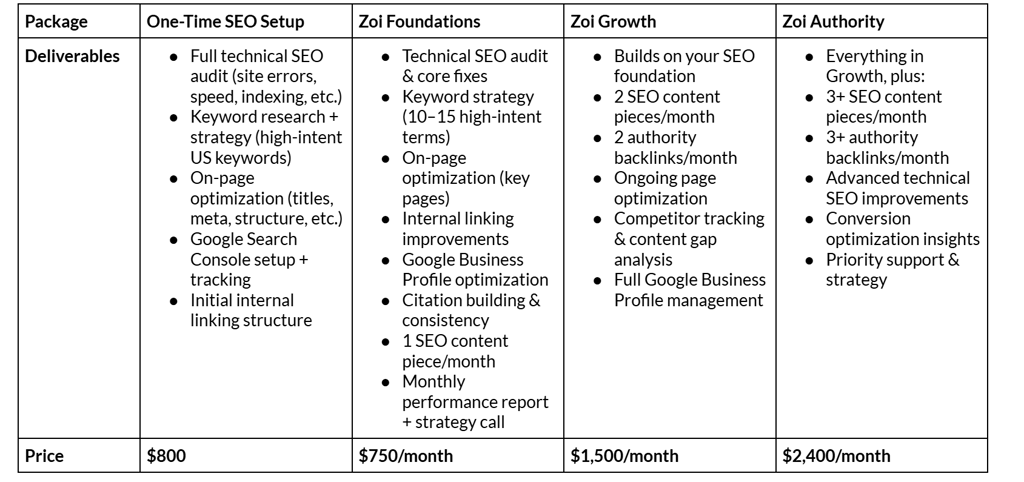
Example of a Deliverables-Based SEO Package (For Comparison)
To help you compare providers, here’s what a deliverables-based SEO package can look like in practice:
SEO Red Flags (And How to Avoid Getting Scammed)
Most bad SEO experiences don’t come from obvious scams. They’re often hidden in unclear expectations, vague deliverables, and overpromises that sound reasonable at first.
These are the common red flags you should watch out for if you’re seeking SEO services:
Guaranteed Rankings
No one can guarantee rankings. Not even the best SEOs.
Because search algorithms change constantly, and competition plays a huge role.
Instead of guarantees, a good provider will talk about probability, strategy, and timelines.
“Thousands of Backlinks” Promises
Volume-based link building is usually a shortcut and a very risky one too. I’ve seen sites hurt more by hundreds of low-quality links than helped.
A better approach focuses on:
Relevance
Context
Real, quality websites (not link farms)
That’s why we focus on manual outreach to relevant, quality sites (not random directories) for building links. These can be guest posts, partnerships, or content placements on real sites.
Zero Transparency on Work Done
If you don’t know what’s being done every month, that’s a problem.
Instead of you having to guess what’s happening behind the scenes, your provider should be responsible for giving you 100% transparency into whatever they’re doing.
At every step of the process, you should know:
What was worked on?
What changed?
What’s next?
I always give our clients a solid list of what we’ll deliver in a month. These are usually:
Site audits (technical + content + competitors)
Keyword mapping to existing and new pages
Number of content updates or new content pieces
And anything else as required
This way, clients know what to expect. And us successfully delivering on our promises means they can easily measure our performance and reliability.
No Reporting (or Very Vague Reports)
A simple traffic screenshot isn’t reporting. Neither is no screenshots at all.
The perfect report should contain:
Work completed
Performance trends
Clear next steps
Without that, it’s hard to tell if anything meaningful is happening. Our reports are highly detailed, often containing:
Summary of work completed that month
Keyword ranking movement
Traffic and conversion trends
Wins, losses, and insights (what’s working and what’s not)
Clear action plan for the next month(s)
“Secret Methods”
There’s no hidden playbook that only a few people know. Because strong SEO is built on well-understood SEO fundamentals, executed well and consistently.
30/60/90 Day SEO Roadmap
Month 1: Foundation & Setup
This is where most of the heavy lifting happens.
Setup & Tracking:
Google Analytics, Google Search Console, and conversion tracking configured
Baseline metrics figured out and recorded (traffic, rankings, conversions, etc.)
Technical Fixes:
Resolving crawl and indexing issues
Fixing broken pages, redirects, and duplicate content
Improving basic site structure and accessibility
Keyword Mapping:
Identifying target keywords
Assigning them to the right pages (existing or new)
Aligning everything with search intent
By the end of Month 1, you will have a clean, trackable, and structured foundation to build on.
Month 2: On-Page SEO & Content Execution
With the groundwork ready, the focus now shifts to execution that drives rankings.
On-Page Optimization:
Updating titles, meta descriptions, headings, and images
Improving service pages with better structure and copy
Aligning content more closely with target keywords
Content Creation:
Creating and publishing blog posts or landing pages based on the keyword plan
Targeting realistic, intent-driven opportunities
Internal Linking:
Connecting pages strategically to improve crawlability and authority flow
Supporting key pages with contextual links
Month 3: Further Optimization & Growth
This is the phase of the process where SEO becomes more data-driven.
Performance Review:
Analyzing what’s gaining traction (keywords, pages, content)
Identifying what needs improvement or adjustment
Optimization Based on Data:
Refining underperforming pages
Updating content based on search behavior
Doubling down on what’s already working
Conversion Improvements:
Improving calls-to-action, layout, and user experience
Making sure increased trafficking actually leads to results with better copy
Monthly SEO Reporting Template (What You Should Receive)
A good SEO report should clearly show what was done, what changed, and what happens next.
This is the comprehensive reporting template we use, which is always rich in data and detail.
1. Executive Summary
Wins
Key improvements (rankings, traffic growth, conversions, visibility gains)
Issues
What didn’t perform as expected
Technical or content-related blockers
Next Steps
Clear priorities for the upcoming month(s)
2. Work Completed
Pages Optimized
List of pages updated (titles, meta, content, structure)
Content Created
Blogs, landing pages, or other assets published
Fixes Implemented
Technical updates (indexing fixes, redirects, internal linking, etc.)
3. Search Performance
Clicks
Number of clicks from search results
Impressions
How often your pages appeared in search
CTR (Click-Through Rate)
Percentage of impressions that turned into clicks
Position
Average ranking position for target keywords
4. Website Performance
Traffic
Total organic sessions/users
Conversions
Leads, sales, or key actions taken by users
5. Local Performance (If Relevant)
Calls
Number of calls generated
Directions
Requests for directions
Website Clicks
Visits from your local listing
6. Insights + Next Actions
What the data actually means (not just numbers)
What’s working and should be scaled
What needs to be improved or changed
Specific actions planned for the next cycle
If your SEO provider cannot show this level of detail, you are likely paying for unclear work.
If you’re not sure which SEO tier fits your business, we can map it out for you. Book a FREE consultation with us today.
Affordable SEO for Small Business: FAQs
How much should small businesses spend on SEO?
Affordable SEO for small businesses usually cost between $500-$5,000/month.
From my experience managing campaigns across local and global niches, budgets below this often limit real progress.
However, a higher spend allows for content, technical work, and authority building together.
Is affordable SEO actually effective?
Yes, affordable SEO services are effective if they’re structured properly.
It works best when focused on high-impact tasks rather than trying to do everything.
In campaigns I’ve handled, prioritizing key pages and fixing core issues often delivered better results than scattered efforts.
Always keep in mind that affordable doesn’t mean “cheap.”
How long does SEO take?
SEO typically takes 3-6 months to show meaningful traction. But it can be longer or shorter depending on your competition and current SEO performance.
From what I’ve done, the first month is usually setup and fixes, followed by gradual ranking improvements in months two and three.
Are backlinks included?
It depends on the provider and package.
In well-structured campaigns, backlinks are usually included as quality-focused efforts.
I’ve done campaigns with and without backlinks included. But when I do, I make sure it’s a quality-focused effort rather than a quantity-focused one.
What should be in a report?
A proper SEO report should include what was done, current performance changes, what’s next, etc.
We use a highly detailed reporting system, which includes:
Executive Summary
Wins
Issues
Next Steps
Work Completed
Pages Optimized
Content Created
Fixes Implemented
Search Performance
Clicks
Impressions
CTR (Click-Through Rate)
Position
Website Performance
Traffic
Conversions
Local Performance (If Relevant)
Calls
Directions
Website Clicks
Insights + Next Actions
Can I do SEO myself?
Yes, but we suggest doing that in the early stages of your business if you want to do it yourself but don’t have any expertise yet.
That said, from my experience, it becomes time-intensive and harder to scale without expertise.
DIY is best for learning and initial traction. It will also come in handy when you’re ready to hire external help, as you’ll be able to gauge their performance from an experienced perspective.
How We Researched This
This guide isn’t based on theory alone. It’s built from a mix of industry data, real deliverables, and hands-on campaign experience.
Industry Pricing Benchmarks
We analyzed how SEO services are typically structured across the market, from freelance platforms to agency offerings.
Across providers, one thing stays consistent:
SEO pricing varies based on scope, time investment, and deliverables
Most structured packages include a mix of:
Technical SEO
Keyword strategy
On-page optimization
Content and authority building
We took all these into account to establish realistic pricing tiers and what businesses should expect at each level.
Our Own Experience
This guide is grounded in actual campaign execution that we did ourselves in the agency.
These insights come from various projects, including eCommerce, local businesses, and niche brands that we helped.
What We Don’t Do
Clear boundaries matter in SEO because they protect your site from cheap short-term tactics that can cause long-term damage.
We don’t ever:
Build spammy backlinks or chase volume for the sake of it.
Guarantee rankings or timelines.
Take shortcuts, quick wins, or hacks.
We follow a simple approach of no shortcuts, no inflated promises, and no work that puts your site at risk! That means following SEO best practices and adhering to search engine spam policies.
Author Bio
I’m Milica, an SEO specialist with 5+ years of experience working with US clients across Shopify stores, local businesses, and service-based companies. I focus on practical, affordable SEO that combines technical optimization, content strategy, and conversion-focused improvements.